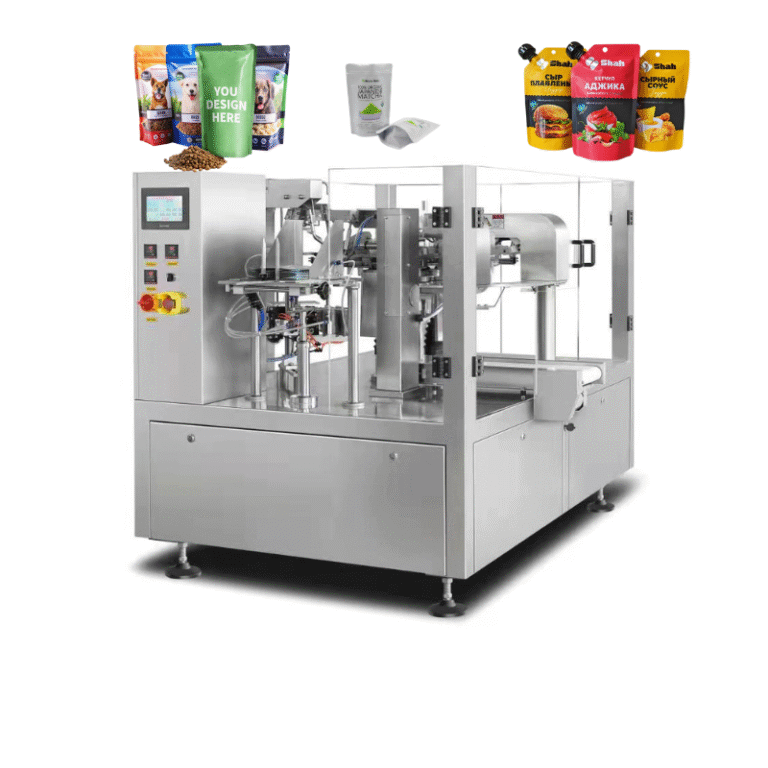
A pre-made pouch packing machine can be considered when your product and preformed pouch fit the equipment’s handling, dosing, sealing, and output conditions. It works with pouches that already exist as finished bags — it does not form them from a roll of film. Whether the machine suits your line depends on four variables: the product itself (powder, granule, liquid, or dried food), the pouch format (stand-up, zipper, flat, or side-seal), the target fill weight, and the required output speed. A doypack packing machine, a term used for the same category of equipment when running stand-up pouches, follows the same logic. No two production lines are identical, so the right configuration always needs product and pouch confirmation before a final specification is set.
Quick Answer
- A pre-made pouch packing machine handles pouches that are already formed, opened, filled, and sealed as bags — not film converted on the line.
- Base pouch compatibility runs 80–200 mm in width and 100–260 mm in length.
- Base filling range is 10–500 g; heavier or lighter targets need configuration review.
- Packing speed sits between 10 and 30 packs per minute, and the real number depends on your product and fill weight.
- Dry products (oats, powders, granules, coffee, tea, spices) may need a separate weighing and feeding setup, not the base machine alone.
- Liquids and sauces need a compatible liquid dosing system — dry-product weighing data does not apply to them.
- Before requesting a quote, have a product sample, pouch dimensions, target fill weight, and target speed ready.
What Is a Pre-Made Pouch Packing Machine?
A pre-made pouch packing machine is equipment that picks up preformed bags, opens them, fills them through a matched dosing system, and seals them. The pouches arrive at the machine already cut and formed. The equipment’s job is handling and closing, not creating the bag shape.
A doypack packing machine refers to the same category of equipment when it is set up to run doypack-style stand-up pouches specifically. The distinction is the pouch format, not a different machine class. Both terms describe equipment built around the same core sequence: pick up the pouch, open it, dose the product, and seal it.
Because the pouch is already made, the machine’s suitability comes down to how well its handling mechanism, dosing system, and sealing station match the specific pouch and product you plan to run.
Which Products and Pouch Types Need Different Filling Configurations?
Products commonly run on this type of equipment include powder, granules, liquid, sauce, tea leaf, coffee powder, coffee beans, dried food, spices, and functional-food ingredients. Pouch formats include stand-up pouches, zipper pouches, flat pouches, 3-side seal sachets, 4-side seal sachets, and doypack.
Not every product and pouch combination runs on one identical standard configuration. Dry products such as oats, powders, granules, coffee beans, tea, and spices behave differently from each other during feeding and dosing. Flowability, dust generation, particle size, and product fragility all affect which feeding or weighing solution is appropriate. A free-flowing granule feeds differently than a fine, dusty powder, and a fragile flake or bean needs gentler handling than a dense granule.
Liquids and sauces are a separate case. They require a compatible liquid dosing system. None of the dry-product weighing specifications in this article apply to them, and no liquid-filling speed, accuracy, pump, nozzle, or viscosity figures are provided here.
Because of these variables, zipper function, pouch material, pouch opening behavior, product behavior inside the pouch, target speed, and fill weight all need confirmation — typically through product and pouch samples or a technical review — before a configuration is finalized.
Pre-Made Pouch Packing Machine Specifications to Check Before Buying
The table below lists the verified base parameters for the pre-made pouch packing machine. Actual suitability for your application still depends on the product, pouch, dosing system, and final configuration selected.
| Item | Verified Information |
|---|---|
| Compatible pouch width | 80–200 mm |
| Compatible pouch length | 100–260 mm |
| Base filling range | 10–500 g |
| Packing speed | 10–30 packs/min; actual speed depends on product characteristics and filling weight |
| Packing accuracy | Deviation ≤ ±1% |
| Total power | 2.3 kW |
| Compressed-air consumption | ≥ 0.2 m³/minute |
| Power supply | 220 V, 50–60 Hz |
| Total machine weight | 250 kg |
| Overall dimensions | 1500 × 1000 × 1300 mm |
A date coder is available as a confirmed optional configuration. If your product line requires batch or expiry coding on the pouch, this should be discussed during the technical review rather than assumed as standard.
How to Choose a Filling System for Oats, Powders, Granules, Liquids and Sauces
Dry products often need a dedicated weighing and conveying configuration rather than relying on the base machine’s dosing station alone. The table below reflects a verified dry-product weighing and feeding configuration. This is not the standard specification of every pre-made pouch packing machine, and it does not apply to liquid filling.
| Item | Verified Information |
|---|---|
| Single weighing range | 50–800 g |
| Average error per bag | 0.4%–1% |
| Weighing precision range | 0.4%–1% |
| Maximum weighing speed | 30 bags/min |
| Hopper capacity | 2,500 ml |
| Driving method | Stepping motor |
| Operation interface | Blue LCD operation interface |
| Power | 0.75 kW |
| Conveying capacity | 10 m³/h |
| Voltage | 220 V |
| Gross weight | 150 kg |
| Height | Customizable |
Liquids and sauces are excluded from this table entirely. They require their own compatible liquid dosing system, and this decision needs a separate technical assessment.
The table below summarizes which variables typically need confirmation for different product categories before a filling configuration is proposed.
| Product Category | Key Variables to Confirm |
|---|---|
| Dry granular products | Flow behavior, particle size uniformity, target weighing speed, dust generation |
| Powders | Dust control, flowability, bridging or clumping tendency, hopper feeding behavior |
| Fragile products | Gentle handling requirement, breakage tolerance, feeding mechanism impact on product |
| Liquids | Compatible dosing system requirement |
| Sauces | Compatible dosing system requirement |
What Determines Actual Packing Speed and Accuracy?
The 10–30 packs-per-minute range and the ±1% packing accuracy figure are both base machine parameters, and neither one is a fixed guarantee independent of your product. Actual speed depends on product characteristics and filling weight — a lighter, free-flowing product and a heavier, denser product will not necessarily run at the same rate on the same machine.
Accuracy is influenced by how consistently the product feeds into the dosing system. A product that flows evenly through the hopper and weighing mechanism tends to hold accuracy more consistently than one that bridges, clumps, or varies in bulk density between batches. Pouch handling also plays a role — how reliably the pouch opens and how consistently it seals affects whether the fill inside matches what is expected in the final package.
For this reason, any speed or accuracy figure quoted for a specific application should be treated as conditional until it is confirmed against your actual product and pouch during testing or sample review.
When Is a Doypack Packing Machine a Good Fit — and When Is It Not?
A doypack packing machine is a good fit when the pouch format is a stand-up pouch or similar doypack style, the product fits within the base filling range, the pouch dimensions fall within the compatible width and length, and the required speed is realistic for the product’s flow characteristics.
When Not to Choose This Configuration Without Further Testing
- Pouch opening behavior is uncertain or has not been tested with the actual pouch supplier’s material.
- The powder has difficult flow characteristics, such as heavy clumping, poor flowability, or high dust generation.
- The product is fragile and sensitive to handling during feeding or dosing.
- The liquid or sauce has high viscosity or contains particulates that have not been assessed against a liquid dosing system.
- The pouch material has not been confirmed for compatibility with the sealing station.
- If the required fill weight or speed falls outside the stated base machine range, confirm whether a matched dry-product weighing and feeding configuration can support the application.
In any of these situations, a technical review with a product and pouch sample is the practical next step rather than assuming compatibility.
A Buyer’s Checklist Before Requesting a Quote
Before reaching out for a quotation on a pre-made pouch packing machine or doypack packing machine, prepare the following:
- A product sample representative of what you intend to pack
- Target fill weight per pouch
- Pouch dimensions (width and length)
- Pouch material and closure type (such as zipper, heat seal, or side seal)
- Required packing speed
- Preferred or required dosing method
- Available power supply and compressed-air capacity at your facility
- Whether date coding is needed on the pouch
- Willingness to support sample testing or a technical review before finalizing a configuration
Having these details ready shortens the technical review process and reduces the chance of selecting an unsuitable configuration.
Application Notes for Oats and Juice
A Philippines customer used a solution for oat packaging, and a Vietnam customer used a solution for juice packaging. These are noted here as brief application references rather than detailed case studies. No output figures, project dates, cost outcomes, equipment configurations, or performance results are available beyond these two facts.
Oats, as a dry product, generally fall under the dry-product feeding and weighing considerations described above, tied to flow behavior and particle characteristics. Juice, as a liquid, requires a compatible liquid dosing system rather than the dry-product weighing configuration.
Frequently Asked Questions
What pouch sizes can a pre-made pouch packing machine handle?
The base machine is compatible with pouch widths of 80–200 mm and pouch lengths of 100–260 mm. Pouches outside this range would need to be assessed separately.
How fast can a doypack packing machine run?
The base speed range is 10–30 packs per minute. The actual achievable speed depends on your product’s characteristics and the target fill weight, so this figure should be confirmed for your specific application.
What is the fill weight range for this equipment?
The base filling range is 10–500 g. A separate dry-product weighing configuration can handle 50–800 g per weighing, but that configuration is specific to dry products and is not a liquid-filling specification.
Can this machine fill liquids and sauces?
Liquids and sauces need a compatible liquid dosing system. The dry-product weighing and feeding data described in this article does not apply to liquid or sauce filling, and liquid compatibility should be confirmed through a technical review.
How accurate is the filling?
The base machine’s packing accuracy is a deviation of ≤ ±1%. Actual accuracy in practice can be affected by how consistently your product feeds through the dosing system.
What compressed air and power does the machine need?
The base machine requires a compressed-air consumption of at least 0.2 m³/minute and total power of 2.3 kW, running on a 220 V, 50–60 Hz power supply. Facility availability of both should be confirmed before installation planning.
What determines the price of a pre-made pouch packing machine?
An accurate quotation requires technical confirmation based on your product sample, pouch details, target fill weight, target speed, and required configuration. No general price figure is provided in this article.
Does the machine support date coding?
A date coder is available as a confirmed optional configuration. If batch or expiry coding is needed, this should be specified during your technical review.
Conclusion
Choosing between a pre-made pouch packing machine and a doypack packing machine starts with a clear picture of your product and pouch — not a generic spec sheet. Dry products need feeding and weighing considerations based on flow and particle behavior, while liquids and sauces need a dosing system built for their specific properties. The base parameters in this article give you a starting reference point, but the configuration that actually works for your line depends on testing and confirmation.
DOZON provides complete packaging solutions and works with long-term, audited manufacturing bases with strict pre-shipment quality control. If you have a product sample, pouch dimensions, a target fill weight, and a target speed in mind, sharing those details supports a more accurate technical review. You can also review the horizontal pre-made pouch packing machine page for additional configuration reference.